When evaluating a multiaxial production line, attention often goes to production speed, automation capabilities, or machine width.
Yet another factor can significantly affect long-term machine performance: the weft carrier motion system.
Traditional rack-driven systems rely on continuous mechanical engagement between moving components. Over time, this can cause wear and increase maintenance requirements. Precise alignment is also critical, while mechanical engagement at higher operating speeds can increase noise and vibration.
For BTU-TECH, this raised a simple engineering question:
Can carrier movement be made simpler, quieter, and more reliable?
A Different Approach to Carrier Movement
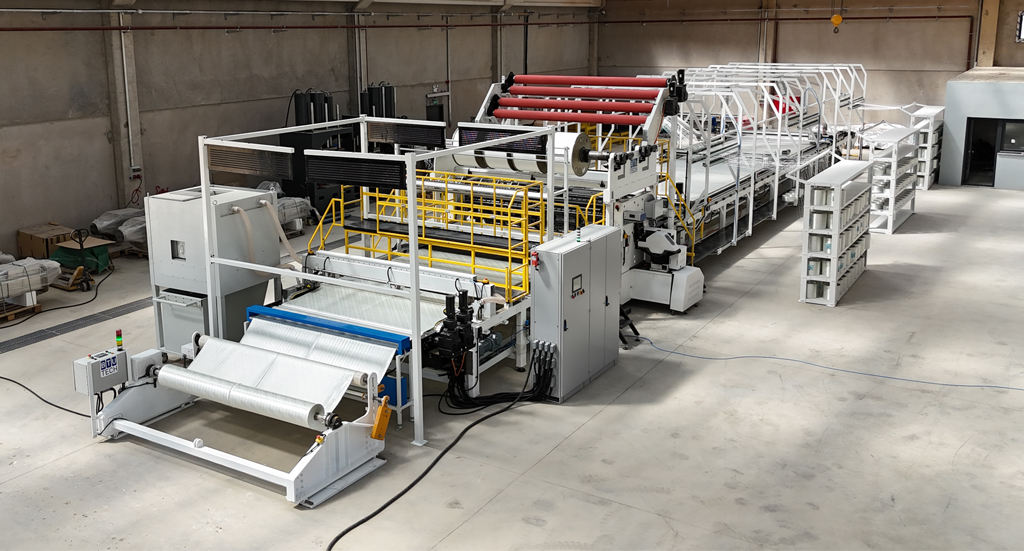
BTU-GMAX replaces the traditional rack-driven architecture with a heavy-duty, trigger-belt-driven carrier system.
The system is designed to reduce wear and noise, improve positional accuracy, prevent carrier jump-offs at high speed, and simplify maintenance. The mechanical architecture is supported by intelligent motion control. Carrier positions are automatically synchronized whenever production starts, eliminating lengthy manual calibration procedures.
Software-controlled carrier positioning also continuously monitors safe operating limits and automatically prevents carrier collisions. Together, these technologies create a carrier movement system designed around accuracy, reliability, and reduced mechanical complexity.
As multiaxial production becomes faster and more automated, improving performance is not always about adding more components or more complexity.
Sometimes, the better solution is to rethink the mechanics behind the movement.
Because better engineering can also mean a simpler way to move.
To learn more about BTU-TECH’s innovative technologies, please pay a visit to the www.btu-tech.com website and, in particular, the innovative https://btu-tech.com/gmax/
To discuss your projects, please contact us via LinkedIn or send us an email: info@btu-tech.com